Signal Quality Control
Signal Quality
Signal quality is a critical determinant of reliable electrophysiological analysis, particularly in sleep EEG where artefacts, channel dropouts, and physiological contamination can vary substantially across recordings. Automated and standardised quality control (QC) procedures are therefore essential to ensure that downstream analyses are not biased by poor signal integrity.
Seapipe provides this functionality via S.Q.U.I.D. (Signal Quality, Uncertainty, Inspection and Denoising) - an automated framework to quantify channel-level signal quality using a range of complementary metrics. These metrics capture temporal stability, amplitude plausibility, spectral composition, signal distribution, and physiological contamination, enabling the identification and flagging of low-quality channels. QC outputs can be generated for individual recordings and aggregated across datasets, facilitating both data-driven channel selection and transparent reporting of signal quality.
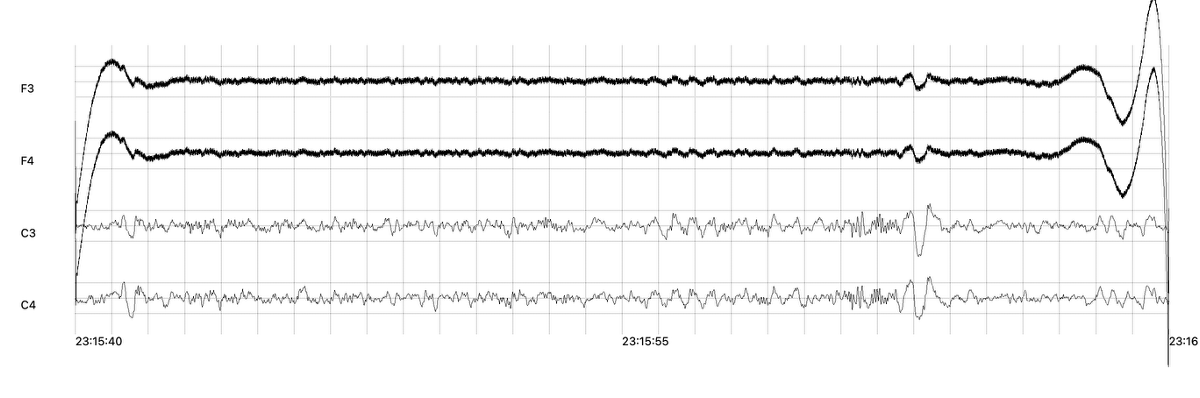
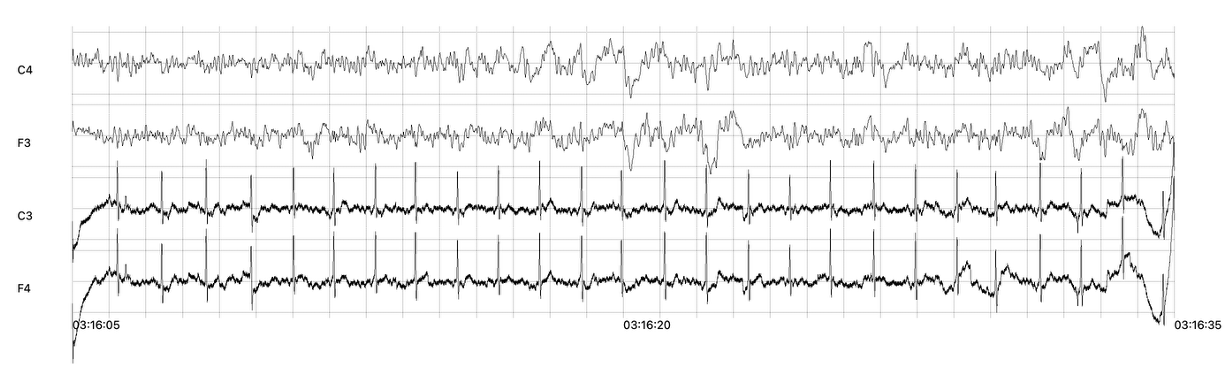
These cases are different from Artefacts in that they contaminate a signal for the majority of the recording. Some examples of poor signal quality include:
Hardware noise
ECG contamination
time_not_flatline: Proportion of time the signal is not flat (based on a moving average).
time_above_10: Proportion of time the signal amplitude is above 10 µV. Flags channels where the signal is of abnormally low amplitude.
time_below_200: Proportion of time the signal amplitude is above 200 µV. Flags channels where the signal is of abnormally high amplitude.
gini_coefficient: Gini coefficient of signal amplitude distribution. The Gini coefficient, traditionally used to measure economic inequality, is applied in signal processing to measure sparsity, impulsiveness, or concentration. A Gini coefficient closer to 1 indicates that the signal energy is concentrated in a few components (high sparsity, low noise), while a value closer to 0 indicates a uniform distribution (low sparsity, high noise/spread).
inverse_power_ratio: Inverse of the ratio of high-frequency to low-frequency power.
ecg_artefact: Measure of ECG contamination based on average correlation between EEG signal and ECG peak .
ecg_artefact_perc: Proportion of EEG signal time with high (r>0.5) correlation with ECG (i.e. contamination).
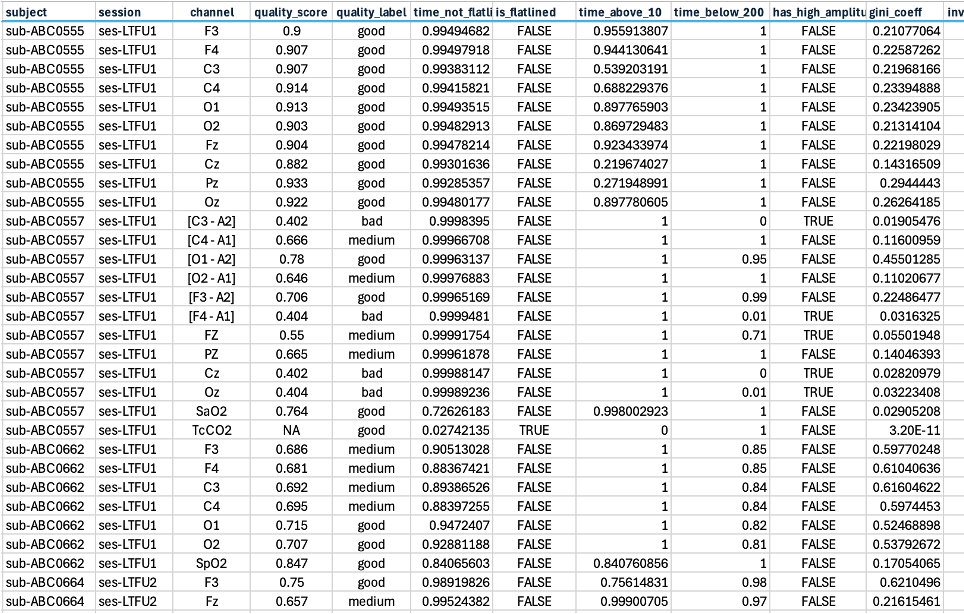
S.Q.U.I.D returns a quality report, including an overall quality_score [0-1] and quality label [bad, medium, good] for every channel.
When to use S.Q.U.I.D
S.Q.U.I.D. is designed for use at the preprocessing or quality control stage of electro-physiological analyses, particularly when working with large datasets, multi-channel recordings, or heterogeneous data sources. It is especially useful when channel quality is uncertain, variable across recordings, or when automated channel selection is required prior to downstream analyses (e.g., automated staging, event detection, or spectral analysis). By providing standardised, quantitative QC metrics, S.Q.U.I.D. facilitates reproducible data cleaning, objective channel inclusion criteria, and transparent reporting of data quality across subjects and sessions.
Functions to implement S.Q.U.I.D
Calculate QC metrics:
project.QC_channels()
/sub-XXX/ses-XXX in <rec_dir> and write QC metrics in to <root_dir>/derivatives/QC/.Export QC dataset:
project_name.QC_summary()
.csv DataFrame file in <root_dir>/derivatives/datasets/QC/Calculate QC metrics
Command line argument:
project.QC_channels(subs = 'all',
                    sessions = 'all',
                    filetype = '.edf',
                    filt = None,
                    chantype = None,
                    outfile=True)
Positional arguments:
- subs (str, NoneType or list)
Subject IDs to analyze
Acceptable options:
Default is
'all'which will point to all thesub-XXX/directories in<root_dir>/rawdata/Entering
Nonewill point seapipe to the sub column in the tracking fileEntering a list of sub IDs (e.g.,
['sub-01', 'sub-02']) will result in detections for those subjects only- sessions (str, NoneType or list)
Session IDs to analyse per subject
Acceptable options:
Default is
'all'which will point to all theses-XXX/directories within thesub-XXX/directories in<root_dir>/rawdata/Entering
Nonewill point seapipe to the ses column in the tracking fileEntering a list of ses visits (e.g.,
['ses-V1', 'ses-V2']) will result in detections for those session(s) within each subject only- filetype (str)
Format of files containing EEG signal
Acceptable options:
Default is
'.edf'formatThe pipeline can also read
.eeg,.setformats- filt (str or NoneType)
Explicit list of channels to process for EEG.
Acceptable options:
Default is
NoneStandard 10-20 EEG channel names will be used.If entering a
str, then this will work to filter only EEG channel names containing this string in the name.- chantype (list or NoneType)
Channel type(s) to process.
Acceptable options:
Default is
Nonewhich will use['eeg', 'eog', 'emg', 'ecg']Entering a subset of this list is accepted, e.g.
['eeg']outfile (bool or str)
Whether to log the process.
Acceptable options:
True, writes log to auto-generated timestamped file in self.log_dir.
str, writes log to the specified file path.
False, logs only to console.
Export QC metrics to dataset
Command line argument:
project.QC_summary(qc_dir = None,
                   chantype = ['eeg', 'eog', 'emg', 'ecg'])
Positional arguments:
- qc_dir (str)
Path to the directory with sub-directories
/sub-XXX/ses-XXXcontaining the saved QC reports.
Default is
Nonewhich will point to<root_dir>/derivatives/QC/- chantype (list)
Channel type(s) to process. Accepted values: .
Acceptable options:
Default is
['eeg', 'eog', 'emg', 'ecg']which will process each of the channel types.Entering a subset of this list is accepted, e.g.
['eeg']